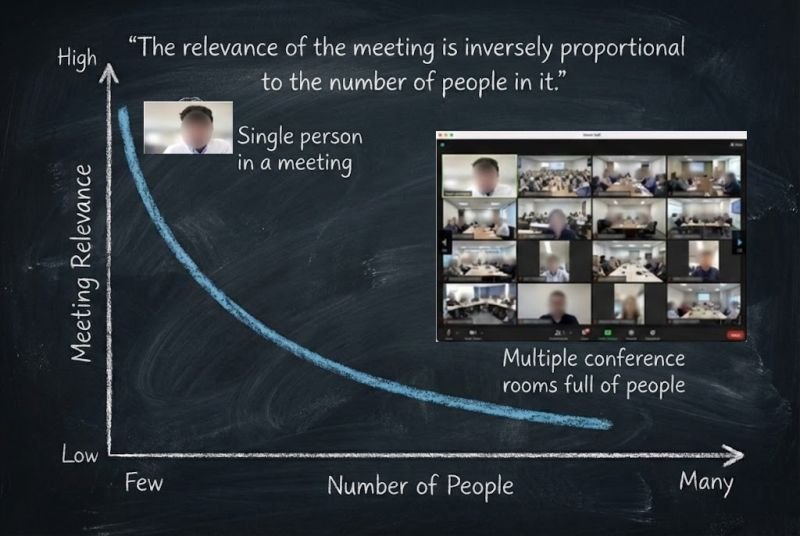
"The relevance of a meeting is inversely proportional to the number of people in it."
Isn't this usually the case? 😅
This wisdom has been expressed before in different ways:
👉 "The usefulness of a meeting is in inverse proportion to the attendance." - Lane Kirkland (president of the AFL-CIO)
👉 "The amount of time taken by any meeting is proportional to the square of the number of people attending. / The number of decisions made by any meeting is inversely proportional to the square of the number of people attending." - Urwin's First and Second Law Of Meetings
👉 "No team should be big enough that it would take more than two pizzas to feed them." - Amazon’s 2-pizza team concept
👉 "Design by committee" - a term that expresses the prioritization of political feasibility at the detriment of technical quality.
👉 "Too many cooks spoil the broth."
Coordination costs increase faster than linearly: as attendees rise, possible communication paths grow ~ n(n-1)/2
Too much "networking" can end up "not working".
Obvious exceptions are: company-wide announcements, stakeholder presence, some onboarding sessions, crisis response, ...
But most of everything else likely needs fewer attendees.